

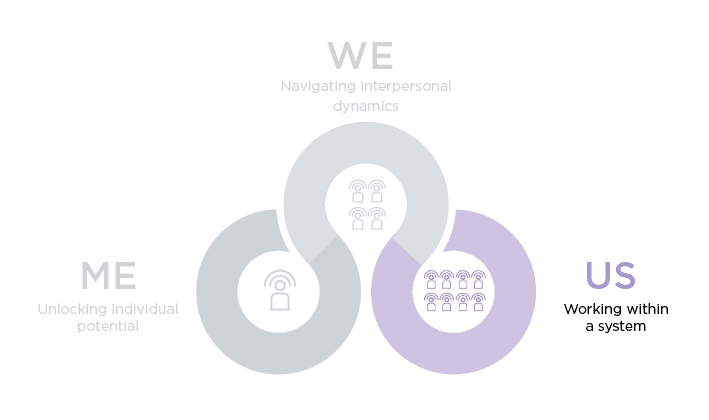
As organisations grapple with the opportunities and challenges that AI adoption brings, understanding and intentionally shaping culture is potentially the most important focus for leaders. We think of culture as ‘the way we do things around here’.
Both tangible (known, visible actions or practices) and intangible (such as symbols, stories told by employees) characteristics make up an organisation’s culture. It is critical to understand and take action to align these characteristics with the organisation’s strategy, purpose, and values.
The critical role of leaders in shaping culture
There is extensive research showing the single biggest influence on organisation culture is leaders. What they say and do, do not say, and do not do, where they focus and what they overlook. Leadership is both informed by, and shapes, context. An organisation’s strategy requires a culture that can deliver on that strategy, and culture is shaped by leadership.
When looking at culture and the role leadership plays in shaping it, we need to ask the question ‘What does it mean to be a leader here?’ and it is imperative that not only the ‘what’ and ‘how’ of management are considered, but that the ‘why’ of leadership is truly weighed up and taken into account.
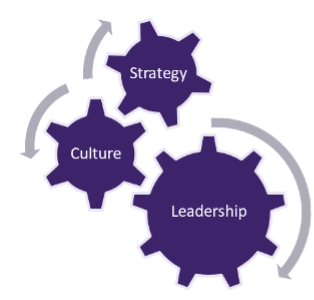
People Measures works with the Adaptive Leadership model in which leadership and authority (management) need to be differentiated from each other. Both are critical; however, leadership is an activity, not a role, and can, maybe even should, therefore be exercised by everybody, rather than expected only from the senior management team.
“The only thing of real importance that leaders do is to create and manage culture. If you do not manage culture, it manages you, and you may not even be aware of the extent to which this is happening”.
Edgar Schein
Shaping a culture that will enable strategically aligned AI adoption
Our work is deeply grounded in organisational psychology and evidence-based approaches. To understand how to shape culture, you first need to understand how it is working today. Your organisation will already have much of the data required – beyond surveys – to understand your culture. We work with you to identify the core data from multiple sources that can be used to develop a picture of the culture today.
In the rapid change environment of AI adoption, culture is the glue that connects individuals, teams and the organisation to stay aligned and focused on what matters most.
Culture as adaptive change
During rapid (e.g. a crisis) or large-scale (such as AI adoption) change it is an organisation’s values and culture that underpin success: the best results are achieved when these inform a set of principles that guide actions and decisions. To help leaders understand their organisation’s culture and how to shift it, we work with the concept of adaptive change (Heifetz and Linsky 2017[1]). This model of change asks the organisation to consider three key questions:
What do we need to keep?
Being clear what to nurture and protect, what is not changing, helps team members feel more in control, and less anxious about change. This in turn enables them to experiment and be curious about what might be different. Often leaders spend too little time here and instead try to ‘sell’ the benefits of what’s changing.
What do we need to do differently (learn)?
It is important to go beyond the tangible changes that are taking place (e.g. we have some new technology that we are implementing to help us adopt AI) and focus on the behavioural level (eg as we adopt AI, what might we need to do differently?).
What do we need to lose?
This is about acknowledging that change always involves loss. A part of loss during change is losing a sense of belonging, and this can have significant impacts on individual engagement and performance (see People Measures’ paper Leading Through Change).
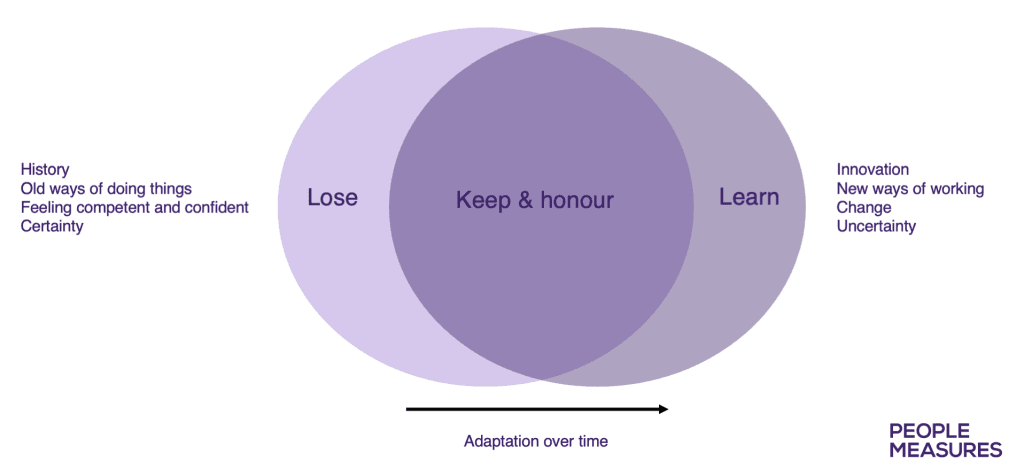
Applying this framework with skilled facilitation ensures leaders have a clear view of what actions will help to progress the aspirational culture. This makes for a much more nuanced (and adaptive) culture change plan.
Understanding your culture through data: The AI opportunity
You already have most, if not all, of the data that you need to understand and track your culture. We help you ask different questions of your HR data, risk data, stakeholder/consumer data, to understand what to focus on in your culture. For example, if you are implementing AI and team members are anxious about adopting new technology, you want them to feel safe to challenge, to experiment and to fail; how will you see this in your data?
Tracking progress over time
Once a view of the current culture has been established (baseline) and the aspirational culture has been agreed upon, we work with you to develop a culture change plan and identify the measures that will indicate progress. These measures can be embedded into KPIs and regular leadership team and one-to-one conversations, to keep the culture and how it is shifting on everyone’s radar – which is likely to be much more effective than an employee survey and action plan.
[1] Heifetz, R. & Linsky, M. (2017). Leadership on the Line: Staying Alive Through the Dangers of Change. Harvard Business Review Press


 Dr Jan Anderson
 Iain Milne