

AI doesn’t fix messy teamwork, it magnifies it. The shift is less about tools and more about a thoughtfully designed “team operating system”.
Why this matters now
Most teams are busy. Some even perform well. But very few are designed around a coherent operating system, an intentional set of routines, roles, and relationships that shape how work gets done. In an AI-saturated environment, speed and scale act like an amplifier.
Where there’s clarity, AI accelerates value.
Where there’s confusion, AI accelerates noise.
The difference is not the technology – it’s the operating system (OS) that leaders steward.
Think of a team OS as the scaffolding that shapes how work, learning, and relationships happen: the shared purpose that guides choices, the roles that prevent friction, the safety signals that invite candour, and the decision pathways that maintain pace without pushing anxiety through the roof. Leaders don’t install this once; they tend it, like gardeners creating conditions for growth.
Four components that quietly change everything
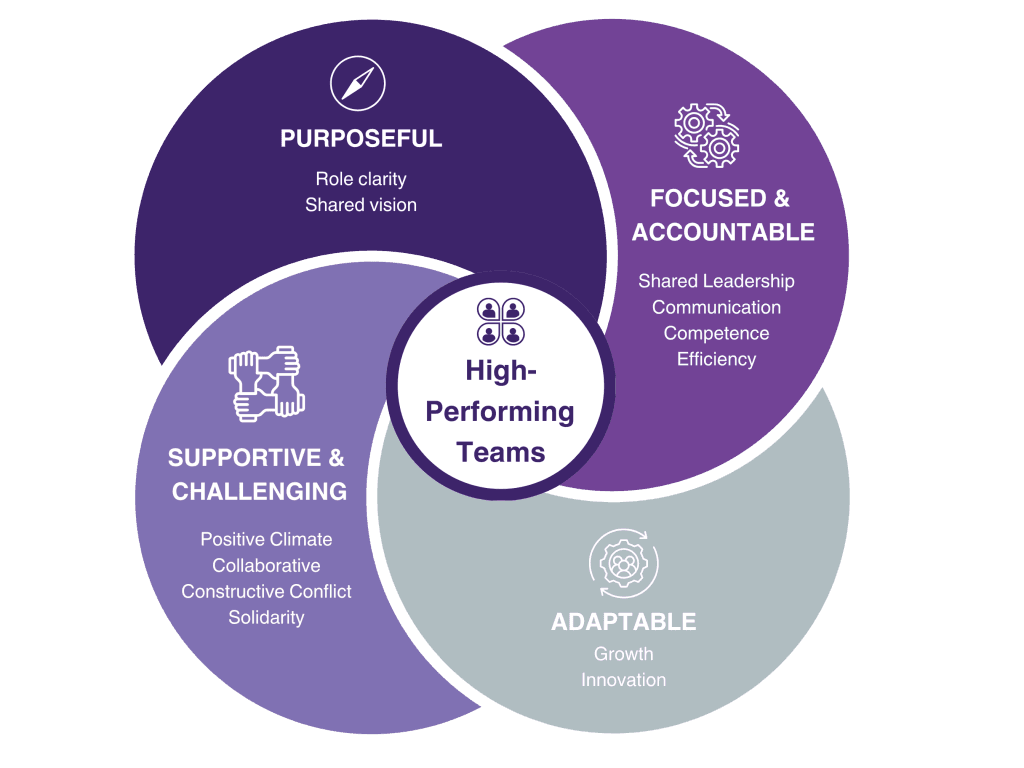
Aligned to the People Measures model of High Performing Teams, the OS combines the structural, interpersonal, and adaptive features that make teams purposeful, focused and accountable, supportive and challenging, and adaptable.
1. Purpose cascade: living clarity, not a poster
Purpose gives attention a home. We encourage leaders to cascade meaning in four layers—organisational context, the team’s distinct contribution, measurable goals, and each person’s line-of-sight. Done collaboratively, this becomes a compass used daily: What business are we in? What difference are we here to make? What matters this quarter? Where do I fit?
2. Distributed leadership: paced through shared leadership
AI expands options faster than one leader can adjudicate. Shared leadership enables teams to stay focused and accountable while distributing decision-making. We map leadership functions such as direction, coordination, quality, stakeholder engagement, development, and improvement, and deliberately allocate them. Done well, the leader stops being the bottleneck and becomes the designer of leadership moments for others.
3. Psychological safety: challenge without fear
Safety isn’t comfort. It’s permission to raise the thing that might save a project. We scan five signals (voice, learning from failure, help-seeking, risk-taking, and trust) then adjust leader micro-behaviours: invite dissent early, thank it publicly, separate standards from shame, and make safe-to-fail experiments routine. This combination of support and challenge builds the positive climate, collaboration, and constructive conflict that sustain high performance, through the disruption of an AI era.
4. Adaptability: learning and renewing together
High-performing teams evolve as their environment changes. Adaptability is about collective learning, monitoring context, experimenting intelligently, and refreshing roles or rituals when needed. Teams that build reflection and renewal into their operating rhythm stay relevant longer and recover faster from disruption. Growth and innovation are outcomes of deliberate learning, not chance.
Cadences that compound
A system lives through its rhythms. Short, human rituals beat grand annual resets. Drawing on the research of Mathieu and colleagues (High Performing Teams), high-performing teams establish predictable routines that support coordination, reflection, and continuous learning:
- Weekly: Decision log and commitments review (15 minutes).
- Fortnightly: Working retro: What did we learn? What will we change?
- Monthly: Role/flow check: Any overlaps, handoffs, or risks emerging?
- Quarterly: OS refresh: Update purpose cues, roles, and decision rights.
These cadences build learning velocity and visible accountability. Crucially, they reduce the ambient anxiety that AI can heighten as people know what happens, when, and why. Over time, the predictability of these rituals becomes the foundation for psychological safety and adaptability, despite the disruption AI can cause.
AI as an accelerant… once the OS is stable
AI can automate reporting, generate insights, and help teams spot patterns—but only if the team already knows what questions it’s trying to answer. With a functioning OS, AI has a clear role: to shorten cycle time, widen search, and derisk experimentation. Without one, AI simply multiplies activity without direction, creating more data, more dashboards, and more noise.
The reflective question to ask is: What would moving with speed using AI reveal about us? Would it expose coherence—or confusion? Alignment—or overload? If the answer suggests fragmentation, the work is not to slow down innovation, but to stabilise the operating system first.
Signals you’re moving from busy to better
- Meetings surface hard truths early; decisions are documented and reused.
- Work moves through the system smoothly: fewer heroics, fewer surprises.
- Experiments are small, fast, and harvested for learning—regardless of outcome.
- Accountability conversations are specific and fair; standards rise without fear rising with them.
From we (team) to us (culture)
Teams with a working OS start to look alike: crisp purpose, explicit roles, safe challenge, shared leadership, and built-in adaptability. Culture is these patterns at scale. Your organisation’s challenge is to connect and sustain the OS across teams: rewarding how work happens, not just what gets shipped.
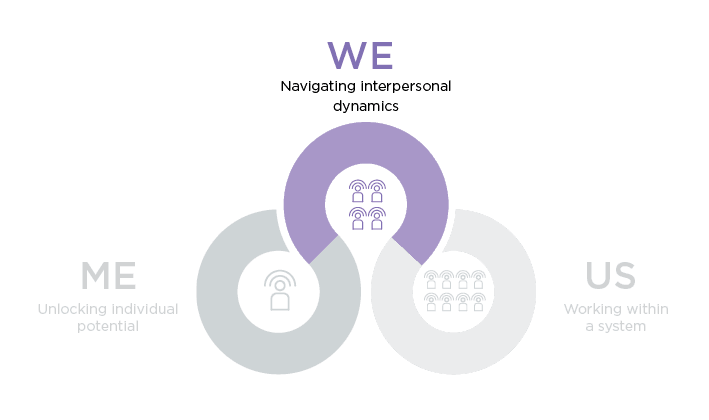
Having examined the Me and We dimensions our final paper will turn to the Us and how organisations embed these team practices into culture at scale.
Experiments to try in the next 30 days
- Run a one-hour Purpose Cascade refresh with your team.
- Co-create a one-page Distributed Leadership Map and test it for two weeks.
- Pick one safety micro-behaviour and practise it every meeting.
- Hold a Team Learning Review focused on adaptability and renewal.
Small, consistent shifts beat grand intentions. That’s the craft.
These routines underpin the evidence-based practices we use at People Measures when helping teams move from potential to sustained performance.


 Chloe Hawcroft
 Dr Jan Anderson