

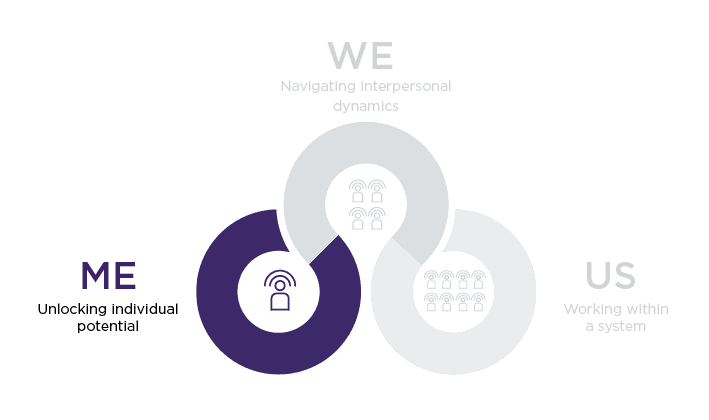
Increasingly, the evidence shows leadership for the AI-era requires the capacity to:
- mobilise people to engage with risk and uncertainty
- foster inclusive decision-making
- carve out enough space for a culture of ongoing learning
- promote ethical experimentation (with appropriate guardrails)
- build psychological safety and resilience in the workplace.
These ingredients are essential when navigating complex and often disruptive AI-driven shifts. Leaders who build trust, model new behaviours, openly engage in conversation with employees about how roles and work are changing, and actively empower their teams to develop the skills necessary for working alongside AI.
This ultimately drives more purposeful AI uptake and better unlocking of the potential of technological investment. In essence, where leadership fails, AI initiatives often stall; and where adaptive leaders thrive, organisations become more innovative, agile, and better equipped to leverage AI as a tool for enduring growth and competitive advantage.
How do we develop these capabilities?
Experiential and adaptive leadership development
As research by the University of Dublin highlights, building AI-ready leadership is partly about adding new technical competencies, but largely about reshaping how leaders view their purpose, make judgements, and connect with both people and technology. In this period of rapid technological change, leaders must strengthen their emotional intelligence, cultivate curiosity, develop greater ease with uncertainty and experimentation, and deepen their ability to promote continuous learning for themselves and those around them.
From experience and extensive research, we understand that the development of AI-ready leadership requires a distinctive approach to leadership development. At the core of our work is the Harvard Kennedy Adaptive Leadership model, a proven framework for leadership and making progress on complex challenges to enable real change. Unlike models that focus primarily on linear change management processes and skill-building, it equips leaders to navigate multifaceted “wicked” problems, addressing the emotional, cultural, and values-based barriers that often inhibit engagement and progress toward organisational goals. We discuss this approach, and its suitability for today’s and tomorrow’s leadership challenges more broadly, here.
Our leadership programs also foster both horizontal and vertical development. Horizontal learning builds practical skills and tools that underpin key leadership behaviours, such as effective coaching, resilience, strategic and systemic thinking, and the types of courageous conversations that build psychological safety for innovative cultures and continuous improvement.
Vertical learning extends this by challenging leaders to examine their underlying beliefs and mental models, encouraging them to explore alternative perspectives and interpretations. This learning is essential to achieving deep, sustained shifts in leadership capability. People Measures helps leaders both expand their knowledge and transform their thinking. We challenge leaders, prompt new ways of reflection, and create supportive yet stretching experiences where the work that drives cultural change and personal growth can truly take place.
Tailored and flexible executive coaching
Unlike traditional education, which typically emphasises the transfer of knowledge, skilled leadership coaching helps provide the personalised support and sustained partnership to help leaders navigate the complex personal and organisational shifts brought about by AI.
Our executive coaching supports all of this in carefully tailored, personalised ways by combining:
- robust evidence gathered through behavioural analysis tools
- partnered human goal-setting, mindset building and skill-development, and
- on-demand virtual AI coaching assistance to help leaders further develop the skills required for AI-driven change.
How do we assess potential for leaders who can thrive in an AI era, and support others to do the same?
The People Measures leadership potential model in an AI era
We define potential as ‘the inherent capacity and orientation to deal effectively with increasingly complex environments, challenges and responsibilities’, and have developed our own research-based framework for potential that predicts future leadership success in the AI era.
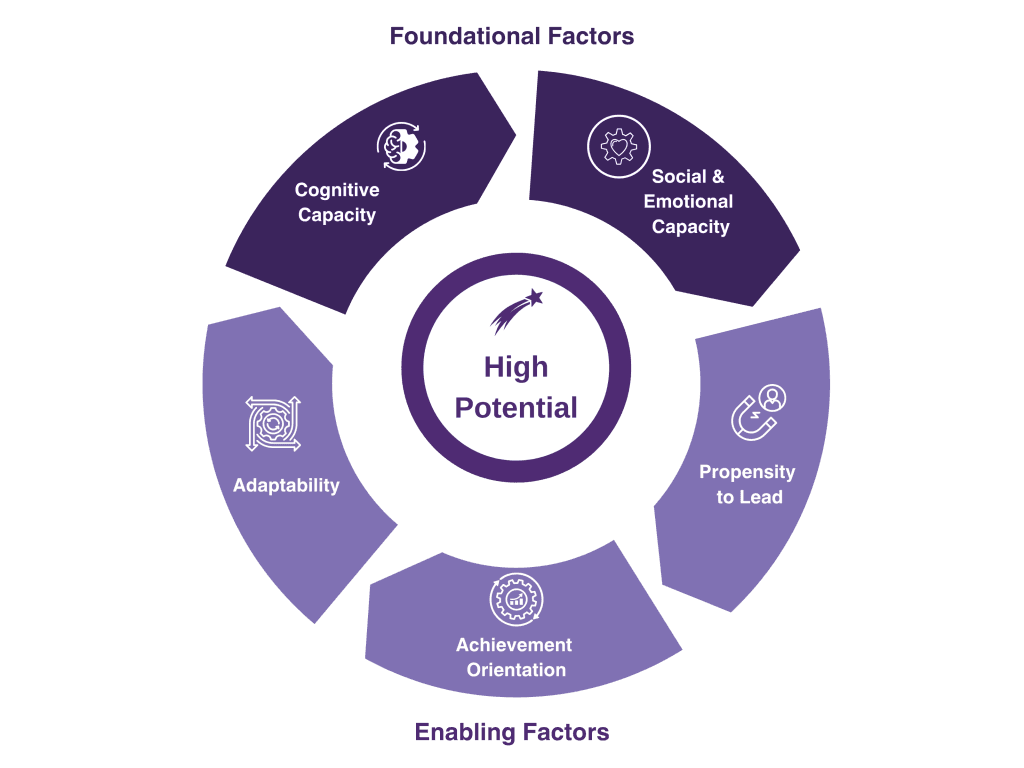
For leadership roles in the AI-era specifically, assessing potential for success (rather than relying on past performance alone) is particularly crucial because:
- The context is evolving rapidly: leaders need the cognitive capacity and learning orientation to grow with emerging technologies.
- Implementation challenges are complex and novel: decision-making capacity and systemic thinking are essential.
- Organisational resistance is common: propensity to lead and emotional intelligence determine success in change management.
- Technical-business integration is critical: adaptability and cross-domain thinking separate successful AI leaders from technical specialists.
By assessing potential alongside specific AI leadership competencies, we can identify leaders who will succeed not just in today’s AI landscape but as the technology and its applications continue to evolve too.
Leading effectively in the AI era requires far more than technical literacy or digital fluency. It demands the ability to navigate complexity with adaptability, empathy, and purpose. At People Measures, we help organisations identify and develop leaders who can bridge human and technological systems, fostering cultures of trust, learning, and ethical experimentation.
Through evidence-based assessment, adaptive leadership development, and tailored executive coaching, we equip leaders to think systemically, act courageously, and guide their people through uncertainty with clarity and confidence. The result is leadership that not only accelerates responsible AI adoption but also strengthens organisational capability for sustainable, human-centred innovation.

 Chloe Hawcroft
 Iain Milne