

When organisations are faced with the challenge of working through mergers, acquisitions, or restructure, transformation is often treated as a technical exercise: new structures, new roles, new systems. Yet the determining factor of success is frequently psychological transition – the human experience of ambiguity, loss, and renegotiated identity while work must continue.
As explored in our white paper Leading through change, transition disrupts identity and belonging, not just processes. When leaders don’t actively steward meaning and connection, uncertainty quietly erodes readiness for the future.
We approach this as adaptive work: helping leaders make progress on complex human challenges where emotions, values and culture are as material as structures and plans. The leadership task is not to make uncertainty disappear, but to help people move through it with agency, dignity and connection.
In a context of ongoing change, this also means shifting from ‘heroic’ leadership to leadership as a shared activity centred on the challenge – a move we explore in Rethinking leadership development: where is the work now?
The practical question for leadership is therefore: how do we support people through the in-between, while transformation is still unfolding?
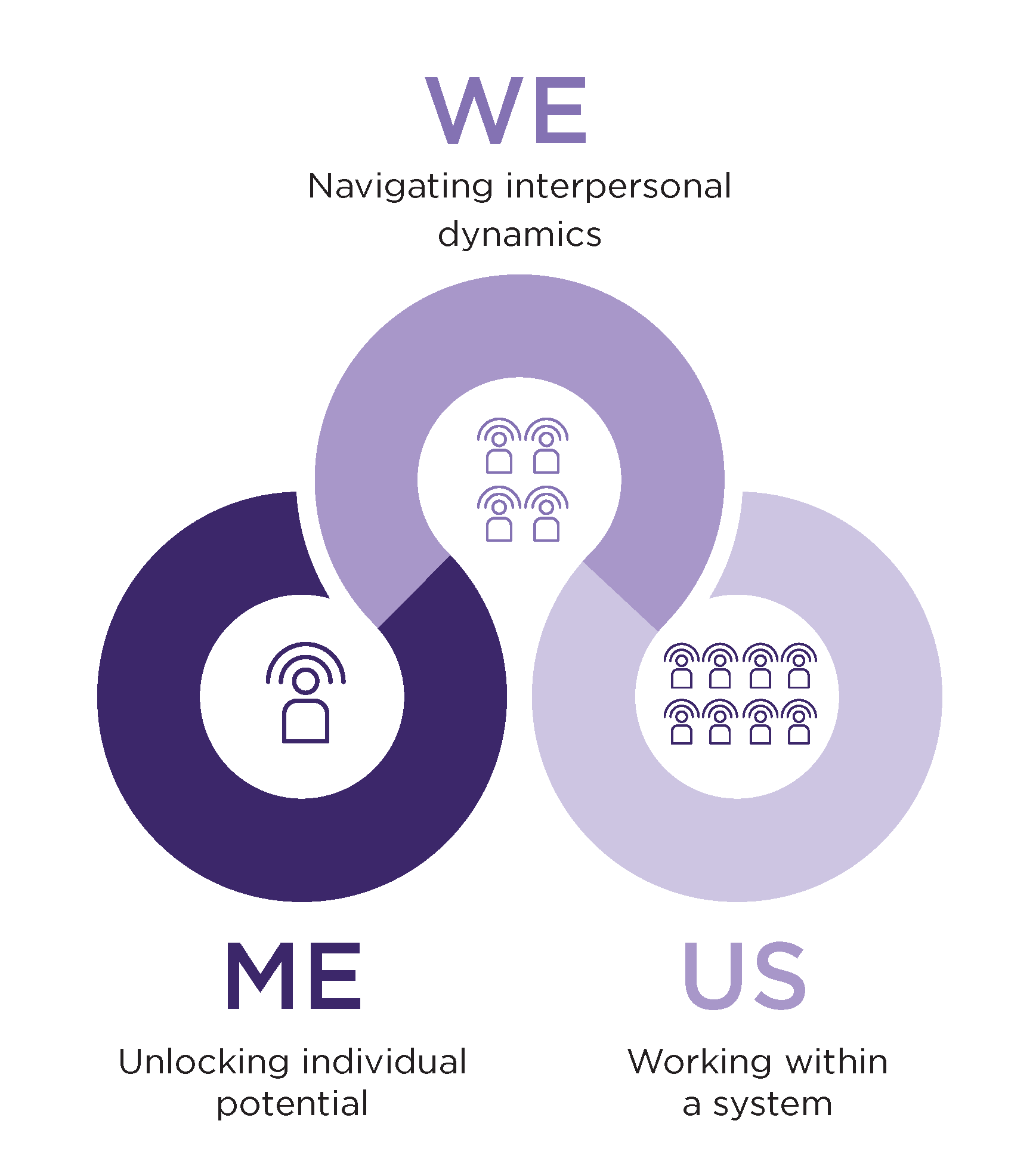
Our Me – We – Us approach provides a practical framework to translate identity and belonging into usable leadership practice:
- Me: How I manage myself in uncertainty – emotions, values, agency, and future self-confidence.
- We: How we lead locally – team trust, shared meaning, and the quality of everyday conversations.
- Us: How the organisation holds continuity and fairness – a story people can still belong to even as structures shift.
The three levels are interdependent. In transition, leaders need to work across them all at once.
This is different from linear change-management training that assumes clarity will do the work; here, leaders learn to work with what can’t yet be resolved, while still sustaining performance.
If you’d like a deeper dive into organisational identity, belonging and the psychology of change, see Leading through change.
What this looked like at TelstraSuper
A live example of leadership as a shared activity through ongoing change.
TelstraSuper entered sustained uncertainty as a merger with Aware Super became increasingly likely, following previous merger investigations that added uncertainty and stress. Leaders needed to keep teams steady and productive while also preparing people for an unknown organisational future.
TelstraSuper asked People Measures to focus on two transition-critical capacities: change readiness and career confidence. We partnered to design a “Ready for Anything” program of two practical four-hour workshops, delivered repeatedly in hybrid format:
- The Leading with Care and Clarity workshop helped leaders strengthen their change readiness by using simple sense-making models for managing uncertainty, clarified controllables and non-controllables, and built practical wellbeing supports to sustain steadiness under ambiguity.
- The Keeping Career Confidence Alive workshop supported leaders to build their career confidence and equipped leaders to hold neutral-zone conversations ethically, anchor in values and purpose, use coaching structures for future-focused discussions, and notice their tendency to provide answers, which enabled people to retain agency.
A key success factor was the development of a productive and collaborative partnership between People Measures and TelstraSuper. Regular briefings with TelstraSuper ensured facilitation reflected leaders’ real experience as merger timelines shifted. TelstraSuper’s steady communications and our shared stance of realism and care created trust in the process.
Client reflection
“People Measures prepared our leaders to support their teams and themselves through uncertain times and to look ahead to their future careers.”
– Krithika Hansen, TelstraSuper
“What worked so well was the partnership and the way Lisa facilitated the work. She created an environment where leaders could bring their real experience, practise leadership in the moment, and leave with practical choices about what they could and couldn’t influence.”
– David Jones, TelstraSuper
What shifted
Participants described the peer container as central: having the space, time and structure to explore what was going on for them and their teams. Cross-business discussions helped leaders feel less alone, share practical approaches, and develop shared language for a live transition. Leaders repeatedly cited the value of simple, memorable models for uncertainty because they translated complexity into practical next steps. They also highlighted coaching questions, role plays, and awareness of their tendency to have all the answers as key outcomes. These techniques have helped strengthen their change conversations and also helped them to avoid providing false reassurance.
Quantitatively, leaders’ recommendation of the program was very strong (average 9.0/10; NPS +64; no detractors), indicating high relevance during uncertainty.
TelstraSuper’s reflection pointed to a system-level insight: the impact came not only from the workshop content, but from how the space was facilitated. Leaders were able to bring real challenges into the room, explore them together, and leave with practical choices about what they could influence.
Three practical lessons for leaders in transition
These lessons reflect an adaptive leadership insight we explore elsewhere: transformation sticks when leaders mobilise people to do the meaning-making work of transition, not just the technical tasks of change.
The same dynamic is now playing out in organisations adopting AI.
- Transition requires a holding environment, not just information
People need structured spaces to share experience, name emotion, and make meaning together.
- Simple models win under stress
In uncertainty, leaders reach for what’s memorable and usable. Low-friction tools create immediate lift in readiness.
- Career confidence is an ethical leadership act
Helping people maintain agency and a viable future-self story protects dignity and belonging, whether they stay or go.
Key take away
Supporting transition is not a soft add-on to transformation. It is the work that makes transformation survivable and sustainable. At TelstraSuper, leaders reported stronger readiness and career confidence, supported by practical tools, a safe peer container, values anchors, and a partnership approach that adapted to a moving reality. That combination helped leaders stay human and effective in the neutral zone – ready for what came next.

 Murray Priestman
 Dr Jan Anderson
 Iain Milne